
Keep verifiable food information and a separate blood-pressure reading. Do not turn “salty” into grams of sodium or make treatment decisions from coincidence.
A worked example
Worked example, using fictional packaging. A label says “salt 1.2 g per 100 g”, but the person eats an unweighed portion. The description retains the label wording and “amount eaten unknown”. An evening blood-pressure reading is saved separately. The result is two observations with a clear limitation, not a calculated salt dose and its effect. Neither “salty” nor an elevated reading supplies the missing weight. This pair cannot prescribe a diet, justify stopping medication or establish the food as the cause.
What to do
- 01
Copy label information with its units and reference amount.
- 02
Describe food and any known amount in text.
- 03
Record blood pressure separately using the agreed measurement procedure.
- 04
Discuss observations with a professional rather than changing diet or treatment after one day.
Common mistakes
- Assess salt only by taste.
- Consider coincidence as a proven cause.
- Self-restrict food intake for medical conditions without advice.
Label content is not automatically the amount consumed
Before comparing anything, check whether a number refers to 100 grams, a serving or the whole package. Do not mix salt and sodium labels without understanding their units and source. If the consumed weight is unknown, retain that limitation. For home cooking without a recipe calculation, a description is preferable to an invented number. Blood pressure has its own measurement conditions; two evening entries do not establish that these were equivalent. The diary preserves source observations for discussion, rather than testing individual sensitivity or prescribing a diet.
How to check the result
- Label data include units and their reference amount.
- Unknown weight remains unknown.
- Blood pressure is a separate measurement.
- No dietary or treatment change is prescribed from the pair.
For the other part of the observation, check what to include in a blood-pressure diary so discussion is not based on two numbers alone.
How this works in Vesometr
Food and pressure entries can be reviewed by date manually. Vesometr does not calculate salt or sodium from descriptions or establish their effect on pressure.
Sources and fact checking
App features were checked against Vesometr 1.2.2. External sources explain general guidance, rather than validating individual medical conclusions.
- Vesometr 1.2.2: official APK — Identifies the release; fields and export limits were also checked against its source code.
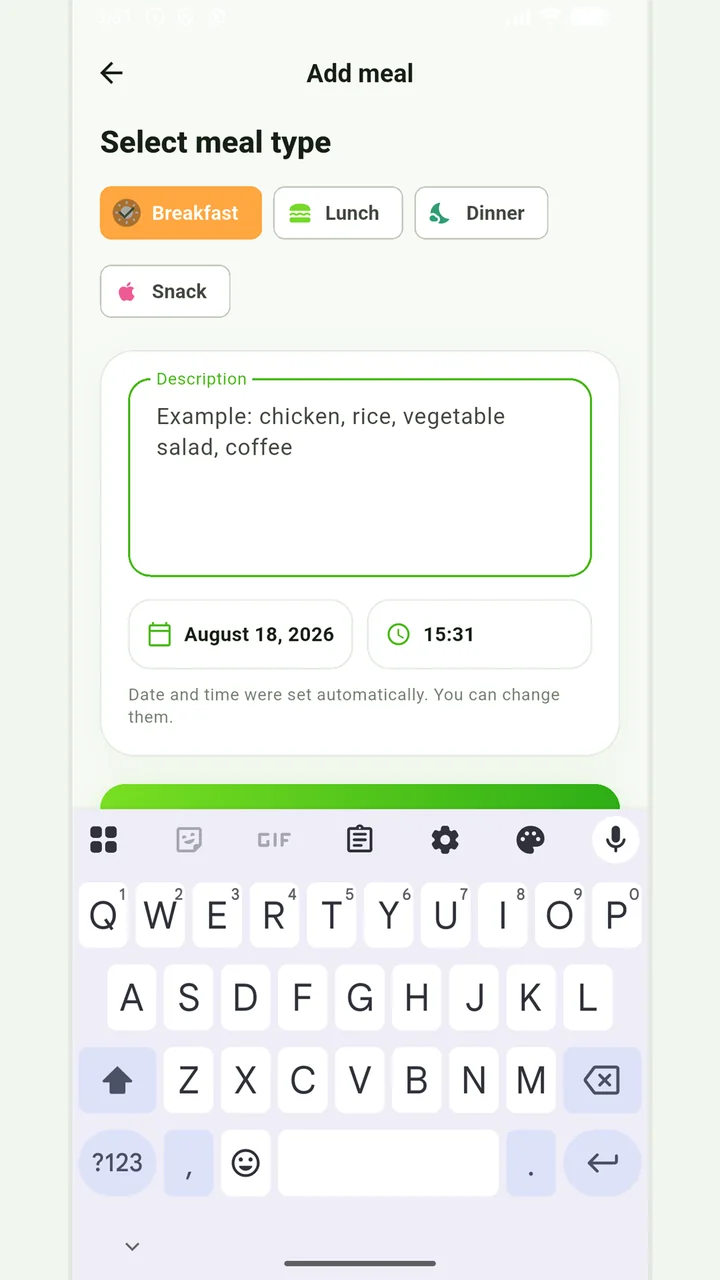
Simple meal journal
Breakfast, lunch, dinner or snack with a description, date and time.
In case of eating disorders, severe dietary restrictions, allergic reactions or a therapeutic diet, it is better to coordinate the observation plan with a specialist.
Medical disclaimer