
How to weigh yourself correctly at home and get comparable values
A clear home weighing procedure helps reduce random noise and see the real dynamics without worrying about every number.
Choose a task: make records comparable, understand a chart, prepare a PDF or preserve your journal. Each guide includes an example, practical steps and checks you can make yourself.
Read the manual, navigate to the appropriate Vesometr screen, and continue with the related content. The application works offline and does not send the log for analysis.
The filter works directly in the browser and does not send anything to the server.
A clear home weighing procedure helps reduce random noise and see the real dynamics without worrying about every number.
Morning and evening weighings answer different questions, but choosing one repeatable time is more important to assess the trend.
Changes in readings over several hours typically reflect water, food, drink and measurement conditions, so intraday numbers cannot be read as a separate trend.
A graph helps you see direction only when you take into account the period scale, omissions, and differences in measurement conditions.
A goal is useful if it sets the direction and method of observation, but does not provoke a daily race for a control figure.
A period without a noticeable change may be a real plateau, normal measurement noise, or the result of an observation window that is too short.
After a few unusual days, the reading may differ dramatically from the usual one, but one measurement does not show the composition of the change.
Weight may change along with the feeling of swelling, but the diary does not establish the cause and is needed primarily for accurate chronology.
The difference immediately before and after exercise primarily reflects short-term changes in fluid and conditions rather than the result of the training program.
A sustainable habit is built around a simple cue and short action, rather than around daily motivation or guilt.
The average value can smooth out some of the everyday fluctuations if there are enough measurements taken in comparable conditions in a week.
Lack of sleep may coincide with changes in routine, appetite and measurements, but the diary should show repeatability rather than declaring causation after one night.
When traveling, measurement conditions are often incomparable: different scales, time, food and time zone make individual values less reliable.
After illness, the weight and regime may differ from usual, so the return to observation should be calm and take into account recovery.
The clinician will benefit from a condensed sequence of comparable measurements and brief context rather than a long list of numbers without dates or terms.
Consistent preparation for measurement reduces the influence of conversation, rush, hand position and other everyday factors on the reading.
An initial comparison of arms can help select a side for further observation, but a consistent difference must be interpreted by a medical professional.
An unsuitable cuff and incorrect positioning can systematically distort the result, even if the tonometer itself is working properly.
A series of measurements without a pause or in a changing position creates a set of disparate numbers and pushes you to choose a convenient result.
Morning and evening recordings are useful when performed during similar windows and linked to an assigned observation plan.
The pulse is sensitive to movement, conversation, temperature and emotions, so the resting value requires a short, standardized preparation.
Post-exercise heart rate depends on the type of activity, intensity, training level and when measured, so without context the numbers are difficult to compare.
Emotional stress may coincide with a change in readings, but a single coincidence does not explain the cause or override the usual medical assessment.
To see whether coffee coincides with changes in blood pressure readings, plan how you will measure and avoid changing several factors at once.
Even a working device does not make different positions comparable, so body positioning should be part of the home routine.
Date, time, pulse, well-being, hand and connection with prescribed medications make the series much clearer for consultation.
Most everyday mistakes are not related to the breakdown of the device, but to haste, conversation, cuff, posture and selective saving of results.
The graph is useful when the series is obtained on a predetermined schedule and does not consist only of measurements at the time of ill health.
For consultation, comparable values over the agreed period, symptoms, pulse and treatment changes are important, not just the maximum figure.
The pressure and conditions of the procedure change, and successive measurements themselves affect the person’s condition, so a difference does not always mean a breakdown.
An up-to-date list helps you avoid confusing names, forms, and purposes and helps you answer questions from your doctor or pharmacist faster.
Build the schedule from the prescription and medicine instructions. The app can remind you of the agreed plan, but cannot change it.
Dosage can mean the content of a substance per unit and the prescribed amount per dose, so the abbreviated notation often becomes unclear.
With a complex schedule, it is important to differentiate each time and not create the same notifications, the meaning of which cannot be understood.
Actions after skipping depend on the specific drug, so there is no universal advice, but an accurate record helps you quickly receive personalized instructions.
The end date helps not to continue the course by inertia and to prepare a question in advance if the doctor planned control or revision.
An inventory list is needed for availability and timing, but it should be separate from the list of what the person is currently taking.
An effective reminder appears at the right moment, clearly names the action and is not lost among duplicate signals.
The trip changes the regime and sometimes the time zone, so it is better to check the plan in advance with a specialist, especially for drugs with strict intervals.
When you take several medicines, pill colour and remembered abbreviations are unreliable. A clear list gives your clinician something to check.
For drugs prescribed on an as-needed basis, it is useful to distinguish what is in the medicine cabinet from each actual episode of use.
Regular checking reduces the risk of discovering an expired or damaged drug at the time it is needed.
A complete list should include prescriptions, over-the-counter products, and supplements that the person actually uses.
Transferring the log and reconfiguring system notifications are different actions, so after recovery you need to check the schedule separately.
It is better to devote the first days to observing the actual numbers and situations, without trying to change all the behavior at once.
An average over several ordinary days is more informative than a memory answer and helps distinguish weekdays from weekends.
The costs become clearer if you take into account the actual quantity, pack size and price in force during a particular period.
The historical price is needed so that the expense report reflects the reality of that month, and not the current cost of the item.
Compare recurring smoking situations through comments without treating a common circumstance as a proven cause.
The plan should be based on an actual baseline, specific situations and available support, not just a promise to smoke less.
A recording of the intensity of desire shows episodes when there was no cigarette, but the usual impulse still arose.
Confirm smoke-free days separately from missing data and keep the context in the Vesometr journal.
One episode does not erase the previous experience, but it is useful to record exactly what happened before, during and after it.
Parallel records of quantity and well-being may show repeating context but do not establish medical causation.
Savings should compare actual costs to an understandable base period and take into account price changes rather than an inflated hypothetical amount.
Check smoking-chart coverage, distinguish gaps from confirmed smoke-free days and compare equivalent periods.
A short recording of the time and composition of food gives a stable picture of the regime, if you do not demand restaurant-level accuracy of descriptions.
Meal times reveal gaps, late meals and links to daily routines, even when the recorded time is approximate.
Household guidelines are suitable for monitoring your own diet if you apply them consistently and do not pass them off as accurate nutritional calculations.
The subjective scale helps to notice the state before and after eating if the numbers have a constant personal meaning.
Snacks are often forgotten not because of intention, but because they occur between tasks and are not perceived as a separate meal.
Drinks can be part of a regimen, a source of caffeine, or a separate context of well-being, so the choice depends on the purpose of the observation.
Home estimates of salt are approximate, especially in prepared foods, so the diary should note categories and frequency rather than giving exact milligrams.
A food diary can explain a change in routine, but it does not allow one to accurately attribute a change in the number on the scale to an individual meal.
When traveling, it is more useful to maintain a general rhythm and unusual circumstances than to try to accurately decipher the composition of each unfamiliar dish.
An honest record of type, amount, and timing is more helpful than a vague holiday designation, especially when discussing sleep, blood pressure, or medications.
Shorten your food-entry template, keep relevant information and resume after gaps without inventing details.
The specialist needs a period appropriate to the question, with an honest description of usual and unusual days and an up-to-date list of medications.
Write a clear short wellbeing note separating mood, sensations, event time and possible explanations.
Use Vesometr’s five mood emojis consistently without treating a personal marker as a clinical assessment.
Distinguish time in bed from estimated sleep and label wearable data separately from personal observations.
Subjective energy reflects many factors at once, so it is helpful to keep assessment times consistent and contextualized.
The context of stress is more useful than a single number by briefly recording the event, the bodily reaction, and the action that followed.
The pain scale helps describe changes in the same sensation over time, but does not indicate cause or determine urgency on its own.
Time helps restore consistency regarding sleep, food, exercise and medications, even when the cause is not yet known.
During illness, keep diary entries brief so they do not interfere with rest, prescribed care or timely medical help.
Review seven dates for one question, inspect gaps and exceptions, and write a neutral observation summary.
A monthly review is useful for the overall picture, as long as you consider the completeness of the records and don't average different symptoms into one confusing score.
The offline application stores work records on the device and does not require an account, but the user is responsible for the copy and selected transmission channels.
The local model reduces automatic transmission, while the cloud model usually simplifies synchronization; the choice changes the risks and responsibilities of the user.
JSON is a structured file for restoring supported application data, not an easy-to-read medical report.
Restore replaces the current data with the contents of the selected file, so you need a separate copy of the current state before you begin.
A safe place should be accessible to the owner, protected from strangers and not dependent on a single telephone.
Internal locking restricts the opening of an application on the device, but does not replace system code, encryption, and careful handling of exports.
A complete deletion clears the local application database, but does not affect copies and PDFs that the user previously saved in external folders or services.
Without an account, the transfer is performed through a local backup, and notifications and system permissions are checked on the new device.
The frequency depends on how much new data you are willing to lose and how difficult it is to restore your first aid kit, notes, and history manually.
JSON restores supported data. The 1.2.2 PDF shows blood pressure, pulse and optional data; medications, meals and the free-form diary are not exported.
PDF combines selected records into a readable document that is convenient to pre-check and show to a specialist.
A diary is useful if it helps you quickly identify the main issue, sequence of events and current medications.
A period that is too short does not show dynamics, and a period that is too long creates noise; the choice depends on the question and recommendations of the specialist.
Quality is determined not by the number of lines, but by clear units, comparable terms, honest omissions, and clear notes.
A specific question links an observation to a decision: whether additional testing is needed, how to interpret the dynamics, or what to monitor next.
In a remote format, a readable file, a secure channel, and a short message explaining the contents of the attachment are especially important.
PDF may contain sensitive information, so the exact destination, private channel, access period, and removal of unnecessary copies are important.
Vesometr 1.2.2 PDF has no medication section. Prepare a separate current list for the consultation and compare it with instructions and actual use.
An annual review is useful as a quick map of changes, but the clinician does not need a complete daily archive without designated periods and questions.
Numbers and notes describe observation, but diagnosis requires clinical context, examination, and sometimes laboratory or instrumental testing.
At the start, you just need to fill out your profile, select one journal purpose and check that the data remains clear to you.
The day screen combines weight, pressure, pulse, nutrition, smoking, well-being and a note, but it is not necessary to fill out all the fields daily.
The calendar shows you which days you have data and helps you navigate from the graph to the primary record with context.
Correction is for typos and incorrect units, not for adjusting the story to the expected dynamics.
Different windows answer different questions: the short one shows details, the long one shows the general picture and changing modes.
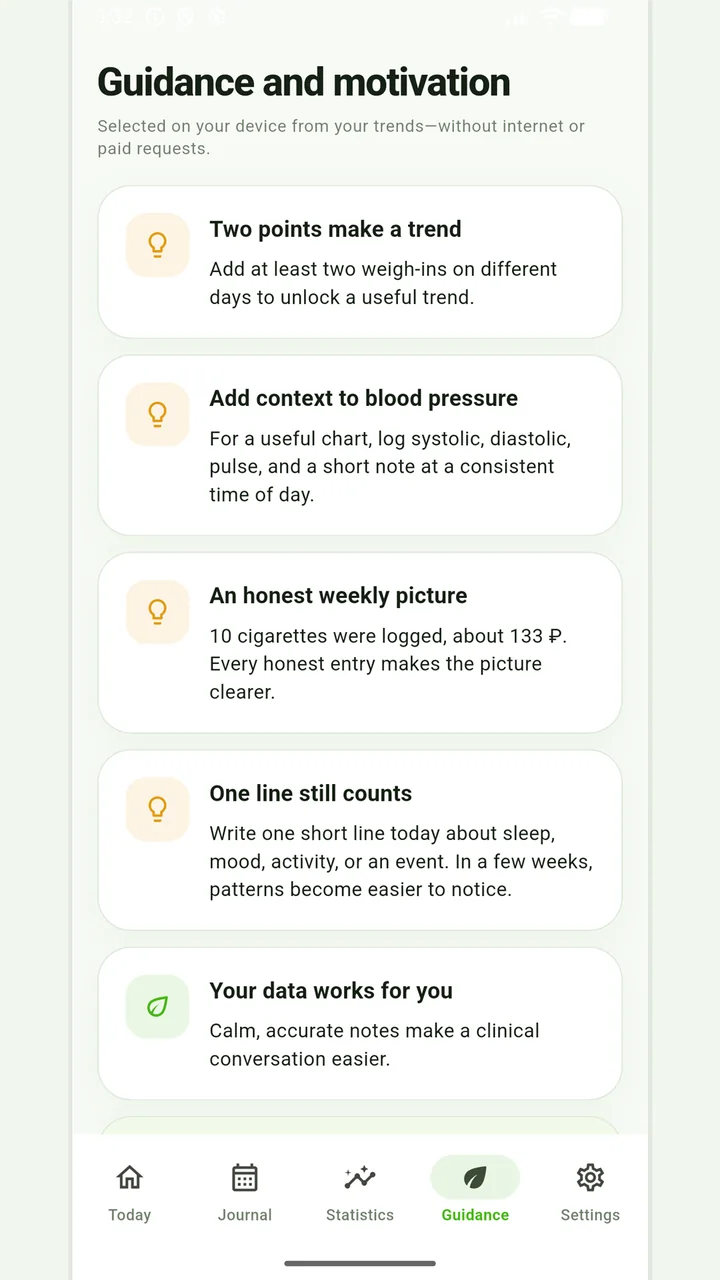
Hints are generated by deterministic rules on the device and do not send a log to the AI model or remote service.
Two languages allow you to choose clear interface captions, but user entries and exported text remain in the form in which the person entered them.
Local reminders depend on Android notification permission, battery settings, system time and an active medicine card.
The profile goal serves as a guide for logging and progress display, but does not calculate a safe pace or create a weight loss program.
The delete command is intended to deliberately clear the local profile and requires a separate decision about backups.
A short procedure helps maintain the log: measure what you need, write it down immediately, add one context and close the application.
A single date simplifies the chronology, but starting all sections at the same time can overload and reduce the quality of records.
Nothing was found for this request. Try shorter wording.