
Choose one question and seven specific dates. Check completeness, repetition and exceptions separately instead of explaining everything at once.
A worked example
Worked example, using fictional notes. Seven dates contain five evening entries. Three mention late work and tiredness, one mentions late work without tiredness, and one concerns a day off. A useful summary says “a repetition and an exception; two days unknown”. It does not establish that late work always causes tiredness. The person chooses one question for the next review: whether workload descriptions are consistent. The result checks observation quality rather than providing a psychological explanation of the week or proving causation.
What to do
- 01
Select the same review day.
- 02
Mark three consistent observations and one question.
- 03
Check for omissions and changes to conditions.
- 04
Assign just one small action for the next week.
Common mistakes
- Create a long list of findings.
- Consider coincidences as evidence.
- Remove data that does not support the hypothesis.
Look for an exception before stating a rule
Repetition is easy to see when searching only for confirming phrases. Review every known day for one selected question and deliberately look for an exception. Check coverage first: a gap is not an ordinary or good day. Then examine whether words such as “tiredness” and “workload” were used consistently. Do not claim an automatic correlation from free text. Finish with a brief observation and an explicit unknown. The next step may be improving a recording definition rather than changing your life in response to incomplete evidence.
How to check the result
- Seven dates and one question are defined.
- Known and missing days are counted.
- An exception was sought and its presence or absence stated.
- The summary separates observation from uncertainty.
If the question remains relevant, carry it into a monthly wellbeing review without mechanically combining incompatible ratings.
How this works in Vesometr
Review calendar dates manually. Statistics chart certain measurements and smoking, but do not calculate relationships between habits, text notes and mood emojis.
Sources and fact checking
App features were checked against Vesometr 1.2.2. External sources explain general guidance, rather than validating individual medical conclusions.
- Vesometr 1.2.2: official APK — Identifies the release; journal behavior and PDF limits were also checked against its source code.
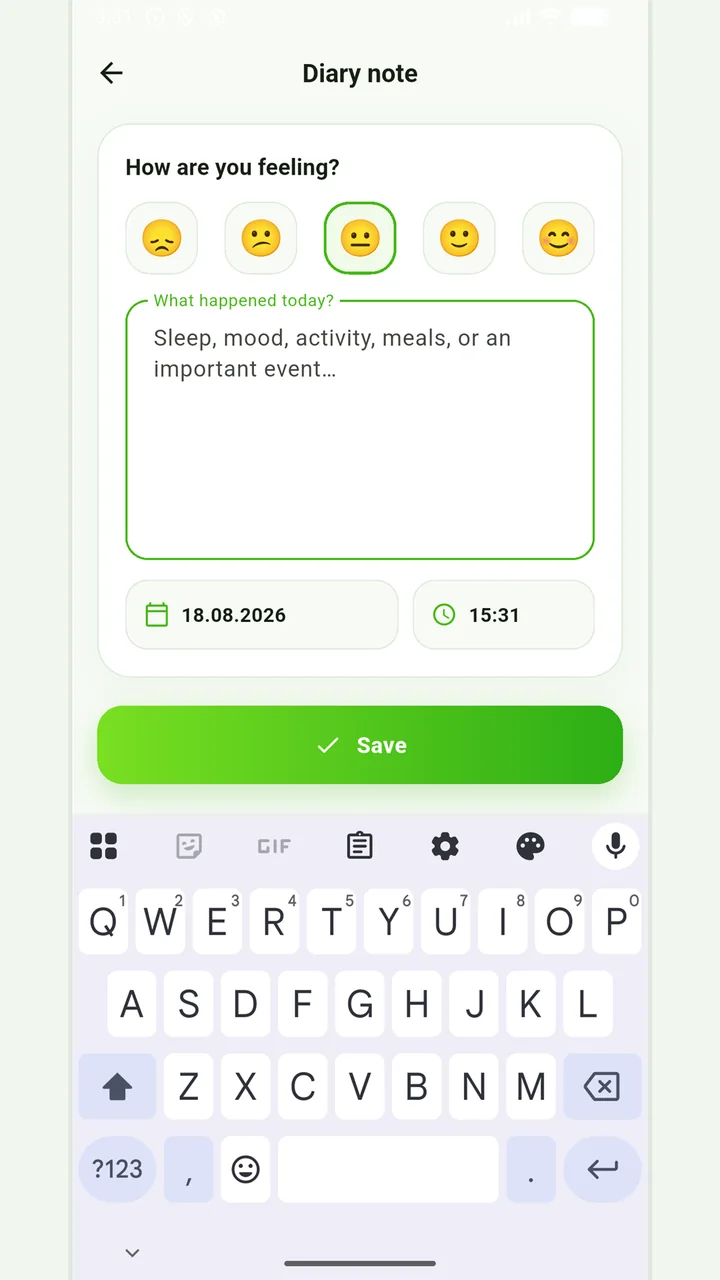
Wellbeing and notes
Mood, a personal rating and free-text context for the selected day.
The article and appendix do not determine the cause of symptoms. If your illness is severe, unusual, or worsening, seek medical attention regardless of your diary entries.
Medical disclaimer