
Establish which days are complete before calculating an average. A confirmed smoke-free day differs from a day with no information.
A worked example
Worked example, using fictional data. Five complete days contain 8, 10, 6, 9 and 7 cigarettes: 40 in total, averaging 8. Saturday is unknown; a separate Sunday note confirms no smoking. Across the six known days, the mean is 40 ÷ 6, about 6.7. This is not a complete weekly average because Saturday is missing. Dividing by seven gives 5.7 but invents a zero. Even the valid average does not show the daily spread or establish a safe smoking level.
What to do
- 01
Record at least one full regular week.
- 02
Separate weekdays and weekends if there is a noticeable difference.
- 03
Sum actual counts and divide by the number of fully known days, including confirmed smoke-free days.
- 04
Store the minimum and maximum value with context as well.
Common mistakes
- Eliminate a stressful day as atypical for no reason.
- Round each value down.
- Consider the average as an accurate norm for the future.
Check the denominator before dividing
Write down both the number of calendar days and the number with reliable information. A day containing only morning entries is not necessarily complete. Include confirmed smoke-free days manually using your notes; the smoking form does not accept a zero count. Label the result with its coverage, such as “six known days out of seven”, rather than reporting an unexplained average. When separating workdays and weekends, identify both groups. A difference describes this particular sample. More comparable periods are needed before calling it a recurring pattern, and the calculation does not assess health risk.
How to check the result
- The calculation states the total, divisor and dates.
- Unknown days were not replaced with zeros.
- Confirmed smoke-free days have supporting notes.
- The daily range appears alongside the mean.
To keep gaps and peaks visible beside the average, check how to read a smoking chart for the same dates.
How this works in Vesometr
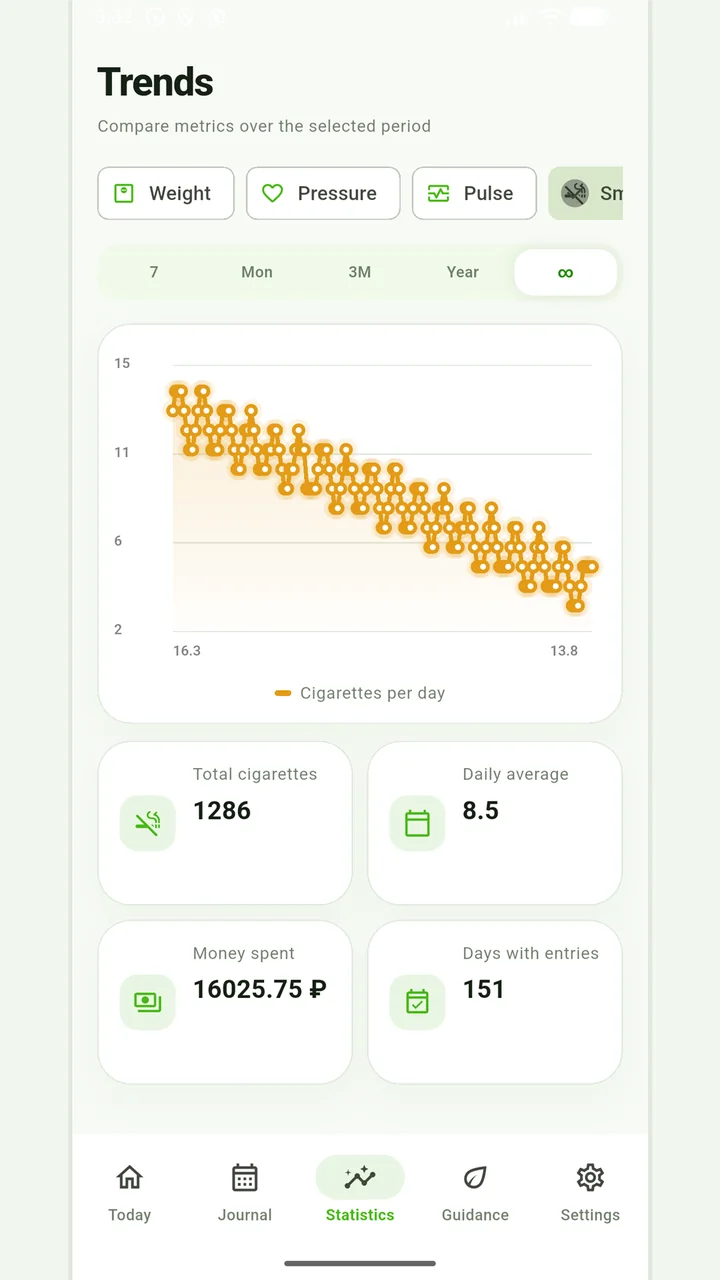
Statistics show daily smoking counts. Check calendar coverage before calculating your own average; a missing entry is not automatically a zero.
Sources and fact checking
App features were checked against Vesometr 1.2.2. External sources explain general guidance, rather than validating individual medical conclusions.
- Vesometr 1.2.2: official APK — Identifies the release covered by this guide; fields were also checked against the release source code.
Habit journal
Quantity, historical pack price, expenses and trends across periods.
The materials do not replace medical care for nicotine addiction. If changing a habit on your own is difficult, discuss evidence-based support with a specialist.
Medical disclaimer