
If observing sensations suits your needs, describe hunger and fullness in your own words. Do not use a rating as permission to eat or a substitute for individual advice.
A worked example
Worked example, using fictional observations. Before lunch, someone writes “noticeably hungry”; afterwards, “full; no discomfort noticed”. Another day says “not assessed”. These preserve personal observations without creating an automatic scale. A review can identify meals with both observations and those without them. “Not assessed” does not mean no hunger, and someone else’s rating cannot be transferred to this person. The diary does not decide how much they should eat or diagnose a condition from sensations before and after food.
What to do
- 01
Choose a few understandable descriptive words.
- 02
If useful, add before-or-after sensations to the food description.
- 03
Separate sensations, events and possible explanations.
- 04
Avoid increasingly burdensome tracking and discuss concerns with a professional.
Common mistakes
- Change the scale value depending on the dish.
- Considering high satiety a moral mistake.
- Use the scale in case of exacerbation of an eating disorder without a specialist.
A personal rating is not an instruction
Before adding a numeric range, ask whether a few consistent words can answer the question. This avoids comparing incompatible ratings with false precision. If a professional recommends a particular questionnaire, follow its definitions in the agreed format rather than treating the app as that questionnaire. Before-meal and after-meal observations describe different moments, so label them. Do not derive a rule such as “I may eat only at this score” from the article. The aim is an understandable record for discussion, not to make the app regulate eating or judge behaviour.
How to check the result
- The observation is identified as personal.
- Before and after eating are distinguishable.
- An absent rating is not a zero.
- Mood does not stand in for hunger or fullness.
To preserve context between main meals, use a separate snack entry with the same clear description.
How this works in Vesometr
Food entries have no hunger or fullness scale. Add such observations in the description. The five journal emojis refer to mood, not hunger.
Sources and fact checking
App features were checked against Vesometr 1.2.2. External sources explain general guidance, rather than validating individual medical conclusions.
- Vesometr 1.2.2: official APK — Identifies the release; food-entry fields were also checked against its source code.
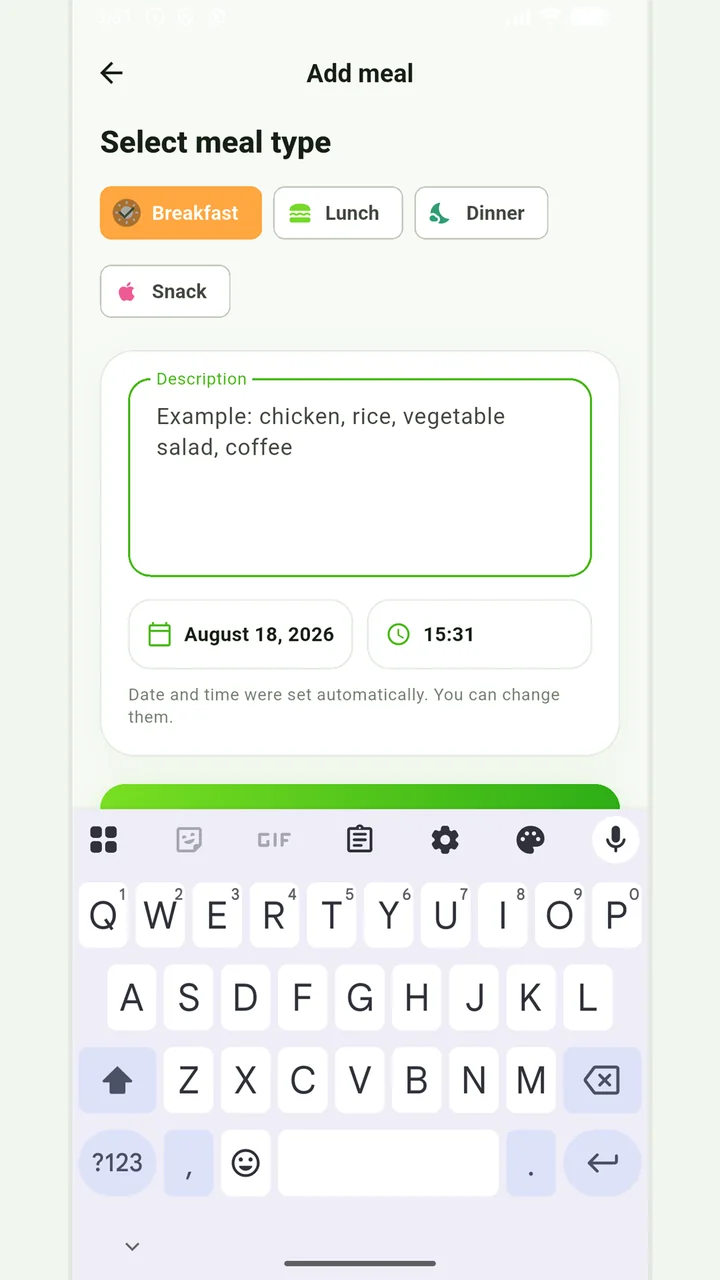
Simple meal journal
Breakfast, lunch, dinner or snack with a description, date and time.
In case of eating disorders, severe dietary restrictions, allergic reactions or a therapeutic diet, it is better to coordinate the observation plan with a specialist.
Medical disclaimer