
Describe circumstances and observable reactions briefly without other people’s names or unnecessary detail. A diary neither diagnoses nor promises to reduce stress.
A worked example
Worked example, using a fictional meeting. Someone writes “tense during a work discussion at 12:00; difficult to follow; calmer around 13:00”. They omit colleagues’ names and other people’s personal stories. The result records an event, approximate duration and their own reaction. “A colleague caused my illness” would be an unsupported explanation. The note does not prove that a break resolved the reaction and is not a psychological test. For review, it is enough to identify a recurring situation and the question they want to discuss.
What to do
- 01
State the time and a neutral situation description.
- 02
Describe a specific reaction in your own words.
- 03
Distinguish observation from an explanation.
- 04
During review, choose one question for which you want help.
Common mistakes
- Keep other people's sensitive information in a note.
- Consider high stress as the sole cause of the symptom.
- Re-read the notes if this worsens the condition, without the support of a specialist.
Preserve an observation, not a conflict transcript
Excessive detail can expose other people’s information and hide the useful point. Describe the situation type and your reaction rather than reproducing a conversation. When writing later, identify the event time and approximate duration. If a professional recommends a questionnaire, use the agreed format: mood emojis cannot replace its questions and scoring rules. During review, do not use one coincidence to prove someone’s responsibility or an action’s effectiveness. Choose an understandable question about a recurring situation. Files exported from the app need separate attention to recipients and storage.
How to check the result
- Unnecessary names and personal details are omitted.
- Situation and personal reaction are distinguishable.
- Causation and effectiveness are not declared proven.
- A mood marker is not described as a stress test.
To avoid rereading everything, use a short weekly observation review focused on one question.
How this works in Vesometr
A journal entry stores text and one of five mood emojis. There is no separate stress scale or automated assessment. The app PIN does not protect files shared outside it.
Sources and fact checking
App features were checked against Vesometr 1.2.2. External sources explain general guidance, rather than validating individual medical conclusions.
- Vesometr 1.2.2: official APK — Identifies the release; free-text journal fields were also checked against its source code.
- NHS inform: What to do if you are struggling with stress — Describes recording circumstances and reactions; it does not establish an app stress-measurement feature.
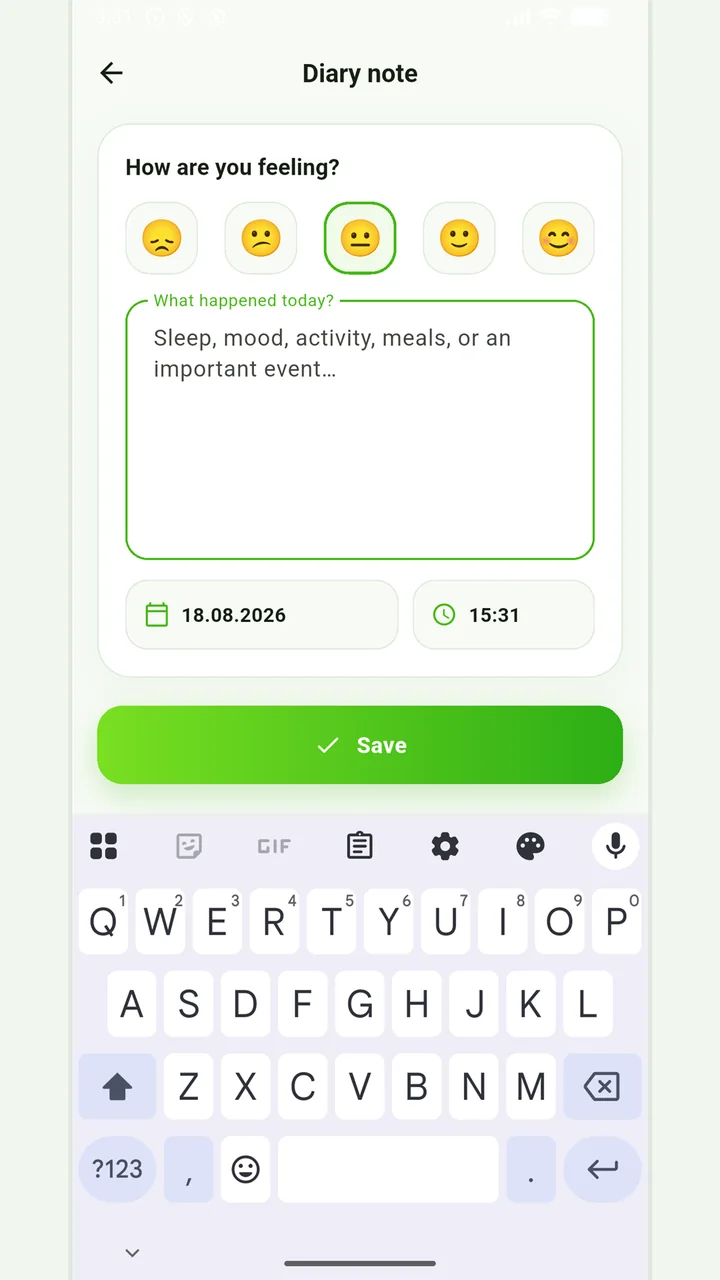
Wellbeing and notes
Mood, a personal rating and free-text context for the selected day.
The article and appendix do not determine the cause of symptoms. If your illness is severe, unusual, or worsening, seek medical attention regardless of your diary entries.
Medical disclaimer