
Use the five available mood emojis with a brief explanation. If a professional requests a questionnaire or ten-point scale, use the separately agreed external format.
A worked example
Worked example, using fictional ratings. Someone defines the neutral emoji as “my usual mood at the moment of recording”. They select it on Monday morning, then record Tuesday late in the evening after a difficult day. A difference may reflect different assessment times as well as mood. During review, they identify that limitation instead of declaring deterioration within a day. The useful outcome is a clear convention for later entries. The five emojis are not a validated questionnaire, and adjacent symbols do not represent equal measured intervals.
What to do
- 01
Review the five emojis and define personal verbal reference points.
- 02
Record at a comparable time of day.
- 03
Explain important exceptions briefly.
- 04
Do not convert emojis into clinical scores or combine them with an external questionnaire.
Common mistakes
- Change the scale depending on expectations.
- Consider an individual low score as a diagnosis.
- Ignore a long-term serious condition without seeking help.
Do not calculate precision the marker does not contain
Emojis quickly preserve a subjective rating, but have no measurement units. Converting them into scores and calculating decimal averages creates unsupported precision. Review your explanations and recording conditions first. A missing day is neither neutral nor good. If your interpretation of the symbols changes, note the date of that change. A questionnaire requested by a professional needs its own questions, rules and separately agreed format; selecting an emoji cannot replace it. The app does not interpret the distribution of mood markers as an assessment of mental health.
How to check the result
- Only the five available emojis are used.
- Their personal meaning is defined consistently.
- Assessment times are comparable or differences are labelled.
- A gap is not replaced with a neutral marker.
For a longer period, begin with a monthly wellbeing summary that states how many days were actually recorded.
How this works in Vesometr
The journal offers 😞, 😕, 😐, 🙂 and 😊. There is no ten-point mood scale, automatic mean or diagnostic interpretation.
Sources and fact checking
App features were checked against Vesometr 1.2.2. External sources explain general guidance, rather than validating individual medical conclusions.
- Vesometr 1.2.2: official APK — Identifies the release; free-text journal fields were also checked against its source code.
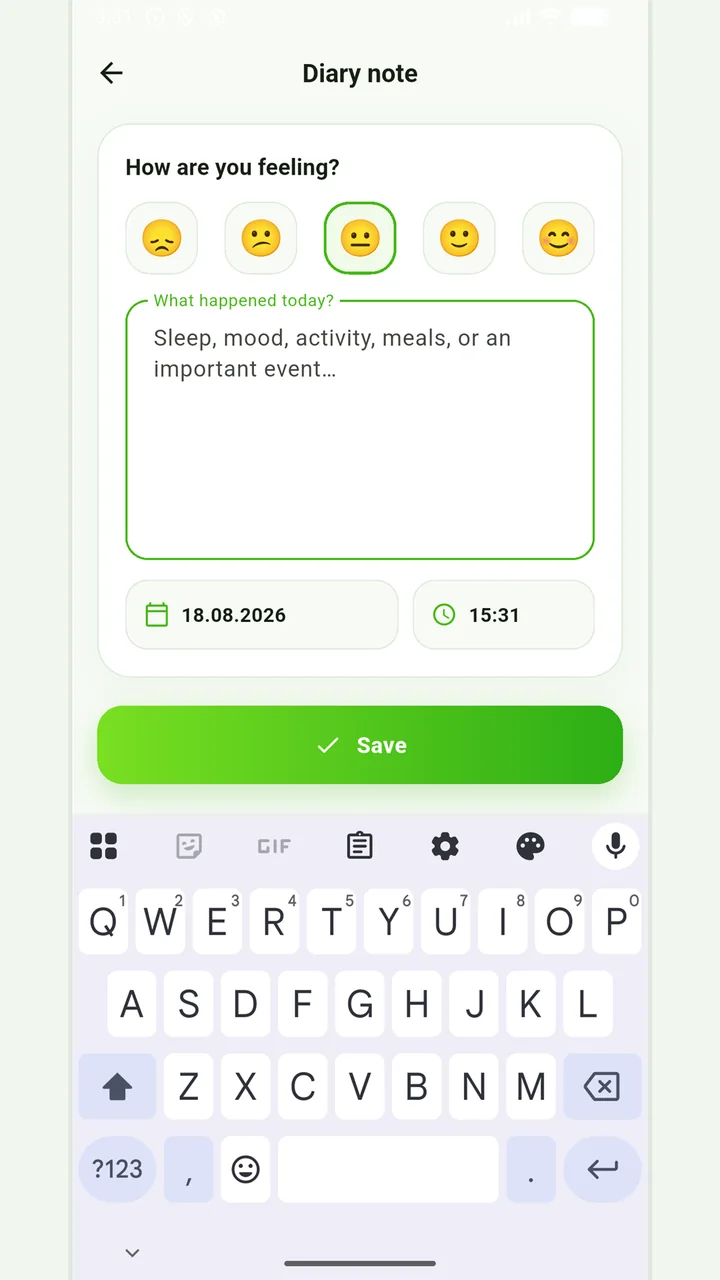
Wellbeing and notes
Mood, a personal rating and free-text context for the selected day.
The article and appendix do not determine the cause of symptoms. If your illness is severe, unusual, or worsening, seek medical attention regardless of your diary entries.
Medical disclaimer