
Capture near-term reliable times and degrees of certainty, rather than creating accuracy after the fact.
A worked example
Worked example, using fictional times. Someone notices discomfort at 18:00 and remembers it was absent at 17:30. They enter the note at 20:00: “started between 17:30 and 18:00; noticed at 18:00”. This preserves a useful range and three distinct moments. Onset must not automatically become 20:00, nor should 17:45 be invented as a measured minute. A later recurrence is described separately. The chronology helps communicate an observation but does not independently determine its cause or urgency.
What to do
- 01
Record the beginning immediately if it is safe to do so.
- 02
If noticed later, please indicate the time range.
- 03
Note duration and repetition.
- 04
Add only relevant events before the episode.
Common mistakes
- Indicate the exact minute by guess.
- Attribute a cause only because the event happened before.
- Wait for the dangerous symptom to recur.
Separate onset, noticing and recording
An event may have an onset time, a moment it was noticed and a later recording time. Preserve what is actually known, including “exact time not remembered”. Do not calculate an uncertain duration from when the form was opened. For recurring episodes, identify any known symptom-free interval rather than merging everything. One general evening note cannot reconstruct unrecorded detail. When care is needed, follow medical instructions first; a tidy diary is secondary. Before sharing, check that the recipient can see the uncertainty range rather than only the entry timestamp.
How to check the result
- Onset and noticing are distinguishable.
- Entry time does not replace event time.
- A time range was not converted into an exact minute.
- Recurring episodes are not silently merged.
For pain, complement the chronology with a pain description and the chosen scale’s rules rather than interpreting the cause yourself.
How this works in Vesometr
A journal entry has a date and time, but they do not automatically identify symptom onset. State onset, duration and uncertainty in text; the note is not included in the BP PDF.
Sources and fact checking
App features were checked against Vesometr 1.2.2. External sources explain general guidance, rather than validating individual medical conclusions.
- Vesometr 1.2.2: official APK — Identifies the release; journal behavior and PDF limits were also checked against its source code.
- MedlinePlus: Headache — Its diary guidance includes onset, duration and circumstances; a record alone does not establish a diagnosis.
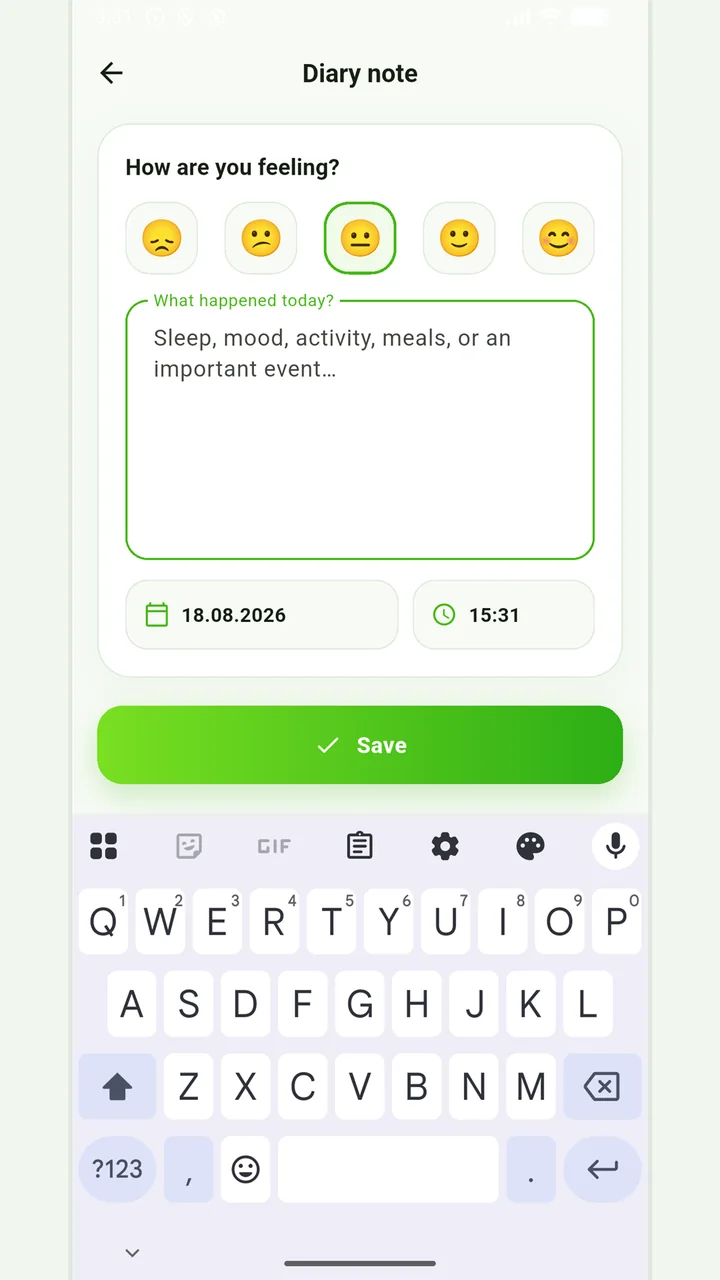
Wellbeing and notes
Mood, a personal rating and free-text context for the selected day.
The article and appendix do not determine the cause of symptoms. If your illness is severe, unusual, or worsening, seek medical attention regardless of your diary entries.
Medical disclaimer